Every year, more surgeons search for the best robotic surgery fellowship in India, and every year, they find dozens of programs, most of them looking nearly identical on paper. Glossy brochures, “hands-on training,” and impressive faculty lists make almost every option sound equally credible. The real differentiator isn’t what’s advertised, it’s the robotic fellowship criteria most applicants never think to ask about until they’re already enrolled.
Here’s what actually separates a fellowship that builds a real career from one that just prints a certificate.
Why Not All Robotic Surgery Fellowships Are Equal?
Robotic surgery fellowships in India range from short observerships to year-long, dual-console mentorship programs, and the difference in actual surgical competency gained can be significant.
India currently has no single, NMC-mandated fellowship structure for robotic surgery. That means “fellowship” can describe a two-week observership where you mostly watch, or a 12-month, dual-console programme where you’re operating under direct supervision from week one. Both get called the same thing. Both hand out certificates.
Bodies like the Society of Advanced Surgical Robotics (SASR) have been pushing for exactly this kind of clarity, evaluating programs on structured criteria rather than brand names, precisely because “fellowship” alone tells an applicant almost nothing.
The absence of one uniform standard makes due diligence the applicant’s job, not the institution’s.
Console Time vs. Observation Time
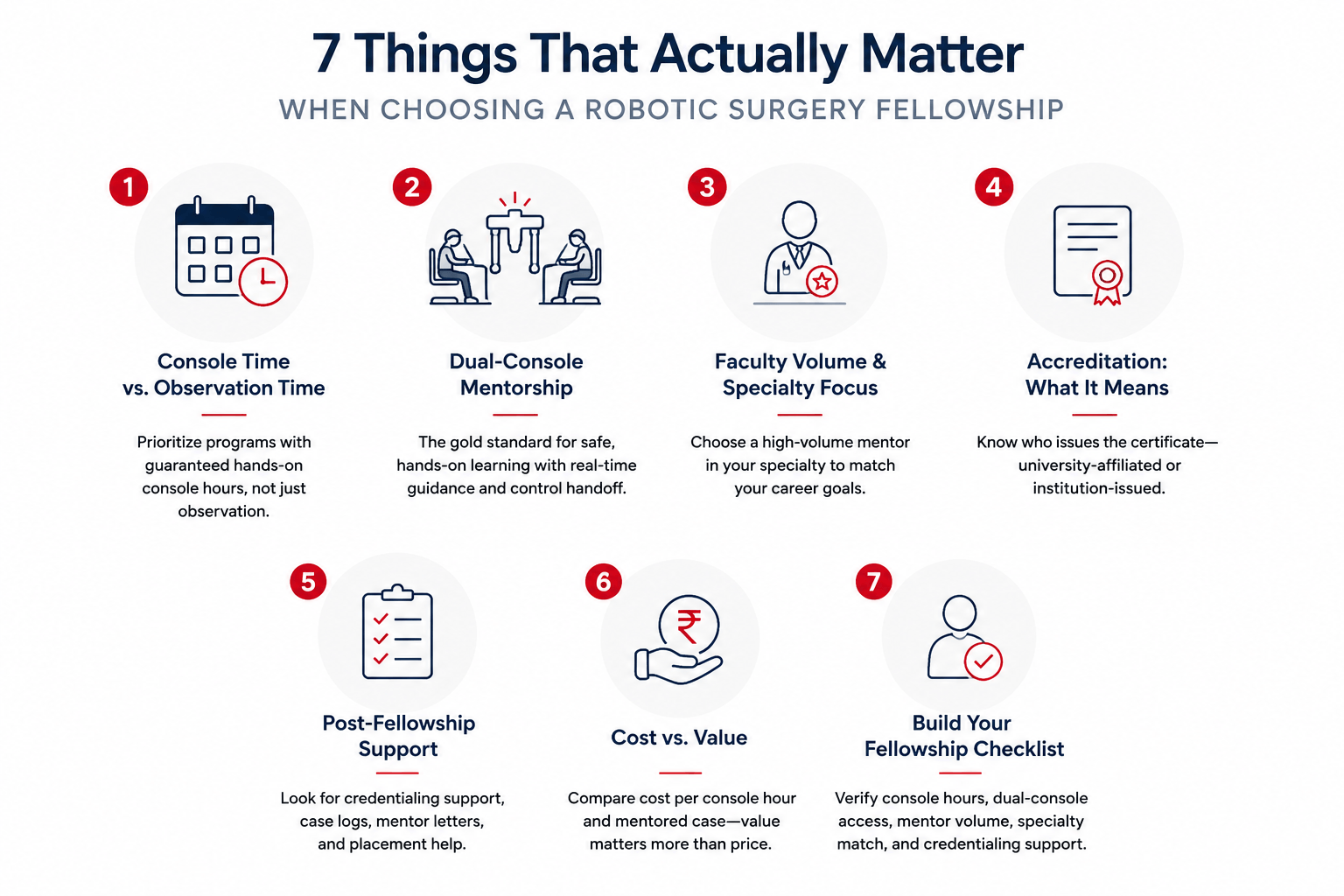
The single biggest differentiator between fellowships is actual console hours under supervision, not just hours spent in the operating room watching a procedure.
Ask this question first, before anything else: how many hours will you personally spend at the surgeon console, not just in the OR?
- Observership-heavy programs: You watch, take notes, maybe get bedside assistant time
- Simulation-supported programs: Validated VR simulator hours before any live case exposure
- Dual-console programs: You operate alongside a mentor who can take over instantly if needed, in real cases.
A fellowship that can’t tell you a specific console-hour or case-count expectation upfront usually doesn’t have one.
Dual-Console Mentorship: The Single Most Important Filter
Dual-console training, where a mentor and fellow operate simultaneously from separate consoles, is considered the gold standard for safe, hands-on robotic surgery skill transfer.
India’s first dedicated dual-console fellowship for robotic surgical oncology launched at a private Delhi hospital specifically because most training programs before it relied on single-console observation. The dual-console setup lets a mentor guide, correct, and hand off control in real time, which is a fundamentally different learning experience from watching over someone’s shoulder.
It’s a model that societies like SASR have increasingly advocated for as the benchmark applicants should look for, rather than treating dual-console access as a bonus feature.
If a program doesn’t have dual-console infrastructure, ask directly how fellows get supervised hands-on time. The answer tells you a lot.
Faculty Volume and Specialty Focus
A fellowship’s value depends heavily on the mentoring surgeon’s personal case volume and whether the program’s specialty focus matches the fellow’s intended practice area.
A fellowship is only as strong as the surgeon mentoring you. Two questions matter more than the institution’s name:
- How many robotic cases has the lead mentor personally performed – not the department, the individual surgeon
- Does the fellowship’s specialty focus match your intended practice – urology, gynaecology, GI/surgical oncology, and general surgery each carry different learning curves, and a program built around one doesn’t automatically transfer to another
A high-volume oncology-focused mentor is the wrong fit for someone planning a urology-heavy practice, no matter how well-known the hospital is.
This is also why mentorship networks such as SASR’s tend to be organised around individual surgeons’ case volumes and specialty tracks, rather than a single generic curriculum applied across the board.
Accreditation: What It Actually Means (and What It Doesn’t)
Fellowship “accreditation” in India can mean a UGC-recognised university degree or simply an internal certificate from the training institute, the two are not the same, and applicants should ask which one they’re getting.
This is where NMC guidelines compliance matters most. As of today, there is no NMC-recognised, formally standardised robotic surgery fellowship curriculum in India, the National Medical Commission has not built robotic surgery into MCh, DNB, or MS syllabi. That means fellowship “accreditation” claims should be read carefully:
- Some fellowships are affiliated with UGC-recognised universities and involve a formal university-level exam
- Others are internally accredited by the training institute itself, with no external academic body involved
- Neither currently substitutes for a government-mandated national credentialing standard, because one doesn’t yet exist
Ask specifically: who is issuing the certificate, and does it carry any recognised academic or professional weight beyond the institution itself?
What Happens After the Fellowship Matters Too
A strong robotic surgery fellowship should include a credentialing pathway or hospital placement support, not just training, since certification alone doesn’t guarantee OR privileges.
Completing a fellowship doesn’t automatically mean a hospital will credential you to operate independently. Since there’s no national credentialing registry, every hospital sets its own bar for granting robotic OR privileges, proctored case minimums, dual-console sign-off periods, or committee review.
A genuinely good fellowship should help bridge that gap:
- Documented, verifiable case logs you can present to a credentialing committee
- Letters of proctored competency from your mentor
- Placement support or introductions to hospitals building robotic programs
- Ongoing mentorship access after the formal fellowship ends
If a program’s support stops the day your certificate is printed, you’re on your own for the part that actually determines whether you get to operate.
Cost vs. Value: Reading Past the Fee Structure
Robotic surgery fellowship fees in India range widely, from under a lakh to several lakhs, and cost alone is a poor predictor of training quality or console time received.
Fellowship fees across India vary enormously, from short courses under a lakh to year-long programs well above that. Price is not a reliable proxy for quality. The better comparison is cost per verified console hour and cost per mentored case, not the headline fee.
A cheaper program with genuine dual-console access and a high-volume mentor often delivers more real competency than an expensive one built mostly around lectures and observation.
Building Your Fellowship Checklist
Before choosing a robotic surgery fellowship in India, applicants should verify mentor case volume, console hours, accreditation type, specialty match, and post-fellowship credentialing support.
Before signing up for any program, get clear answers on:
- Exact console hours and case-count expectations, in writing
- Whether training includes dual-console mentorship or observation only
- The lead mentor’s personal robotic case volume in your specialty
- What accreditation actually means, university-affiliated or institution-issued
- Whether the program supports post-fellowship credentialing at a hospital
Choosing the best robotic surgery fellowship in India isn’t about picking the most recognisable name, it’s about matching real, verifiable training criteria to the practice you’re actually trying to build. Organisations like SASR have built their fellowship structure around this exact checklist, which is as good a benchmark as any to measure other programs against.
